INDONESIA IMPORT MARKET INSIGHTS: KEY PRODUCTS, OPPORTUNITIES & TRADE OVERVIEW
Indonesia’s import market plays a critical role in sustaining its industrial growth, infrastructure expansion, and rapidly evolving consumer economy. As Southeast Asia’s largest economy, Indonesia relies on imports of machinery, mineral fuels, electrical equipment, chemicals, vehicles, and healthcare products to support manufacturing, energy production, and urban development.
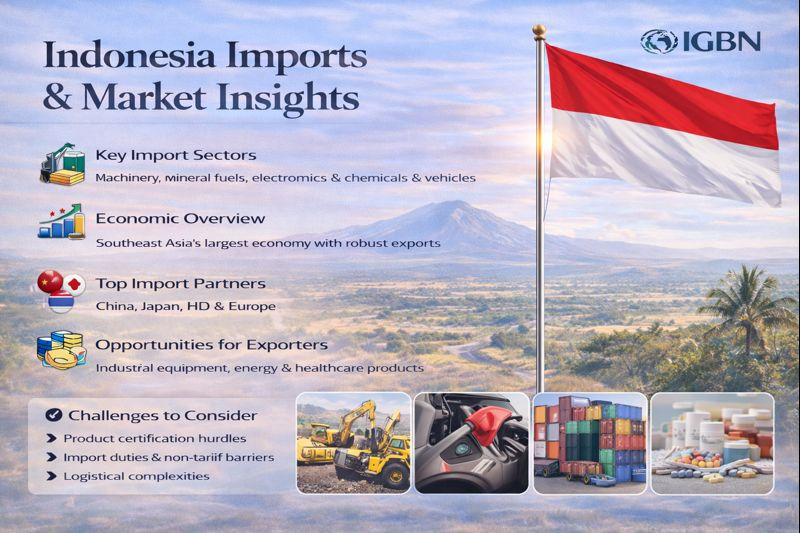
For global exporters, Indonesia represents a high-volume, long-term import destination with strong demand across multiple sectors.
Economic Overview
Indonesia has a diversified and resilient economy with a GDP of approximately USD 1.1 trillion, making it the largest economy in Southeast Asia and one of the top 20 globally. Imports account for nearly 18% of GDP, reflecting the country’s dependence on foreign technology, raw materials, and capital goods. Manufacturing, construction, energy, transportation, and digital infrastructure continue to drive import demand as Indonesia invests heavily in modernization and industrial upgrading.
Political and Regulatory Environment
Indonesia operates under a stable democratic system and is an active member of the ASEAN Economic Community (AEC) and the World Trade Organization (WTO).
The government encourages foreign trade while protecting strategic domestic industries. Importers and exporters must comply with local certification requirements, customs documentation, product standards, and sector-specific regulations. While regulatory procedures can be complex, ongoing reforms aim to improve trade facilitation and customs efficiency.
Opportunities and Challenges for Exporters
Key Opportunities
Rising demand for industrial machinery, spare parts, and automation equipment
Strong import requirements for fuel, electrical machinery, and renewable energy components
Expanding healthcare sector driving imports of pharmaceuticals and medical devices
Growth in automotive, electronics, and construction industries
Key Challenges
Product certification and local compliance requirements
Import duties and non-tariff barriers on selected categories
Logistical complexities due to Indonesia’s island-based geography
Top Import Product Categories (Indonesia)
Machinery (HS 8479) – Essential for industrial plants, construction, and manufacturing
Mineral Fuels & Oils (HS 2710) – Supporting energy generation and transport
Electrical Machinery (HS 8501) – Used in power, automation, and telecom sectors
Vehicles (HS 8703) – Passenger and commercial vehicles
Pharmaceuticals (HS 3004) – Growing demand for healthcare and medical treatment
Organic Chemicals (HS 2901) – Inputs for manufacturing and agriculture
Iron & Steel (HS 7208) – Infrastructure and industrial construction
Plastics (HS 3901) – Packaging, consumer goods, and manufacturing
Food & Beverage Products (HS 2207) – Meeting rising consumer demand
Medical & Optical Instruments (HS 9018) – Expanding healthcare services
Indonesia’s Major Import Trading Partners
Indonesia sources the majority of its imports from China, Japan, and Thailand, followed by regional and global suppliers across Asia and Europe. These partners collectively contribute over 80% of Indonesia’s total import volume, reflecting strong regional trade integration and established supply chains.
Key Import Gateways in Indonesia
Indonesia’s import activity is supported by a robust port and logistics network. Tanjung Priok (Jakarta) and Tanjung Perak (Surabaya) are the primary maritime gateways, while Soekarno-Hatta International Airport plays a significant role in air cargo imports. These ports ensure smooth movement of industrial goods, consumer products, and raw materials across the country.
How IGBN Supports Global Exporters Entering Indonesia
IGBN helps international exporters navigate Indonesia’s complex import environment by identifying the right buyers, ensuring regulatory readiness, and facilitating direct business connections. Through on-ground trade intelligence and buyer outreach, IGBN enables exporters to enter the Indonesian market with clarity, confidence, and reduced risk.


Comments