India Rice Market Update 2026: Basmati & Non-Basmati Rice Export Trends, Global Demand, Pricing Analysis, and Trade Opportunities
India continues to dominate the global rice trade landscape in 2026, maintaining its position as one of the world’s largest exporters of both Basmati and Non-Basmati rice. From the Middle East and Africa to Europe and Southeast Asia, Indian rice remains a preferred choice due to its quality consistency, large production capacity, competitive pricing, and strong export ecosystem.
As international buyers become more strategic in sourcing agricultural commodities, the rice market is witnessing significant shifts driven by geopolitical tensions, freight fluctuations, changing consumer demand, supply chain diversification, and increasing focus on food security.
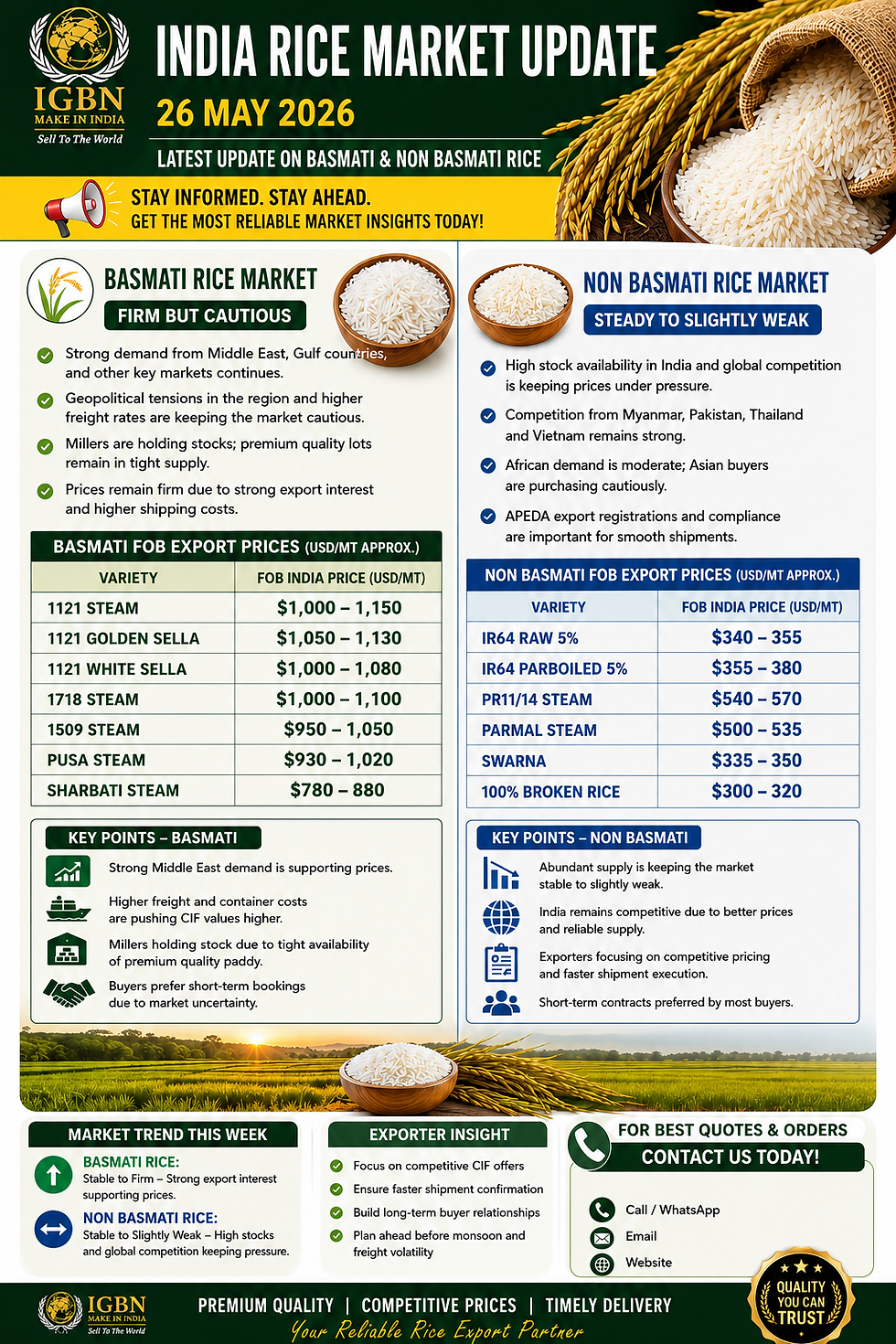
The current rice market environment reflects two different market behaviors to understand India rice market update 2026:
Basmati rice continues to remain firm due to premium demand and limited availability of high-quality stocks.
Non-Basmati rice markets are stable to slightly weak because of higher stock availability and strong global competition.
For importers, distributors, wholesalers, food brands, supermarket chains, and institutional buyers, understanding these market dynamics has become critical for procurement planning and long-term supply strategies.
At IGBN (Indian Global Brands Network), we continuously monitor international trade trends, buyer behavior, freight movements, supplier capabilities, and export pricing to help global buyers and Indian suppliers make better trade decisions.
Overview of India’s Rice Export Industry - India rice market update 2026
India remains a strategic supplier in the global rice market due to several major advantages:
Large-scale rice cultivation across multiple states
Diverse rice varieties catering to different price segments
Strong milling and processing infrastructure
Competitive export pricing
Reliable shipment capabilities
APEDA-regulated export systems
Experienced exporters and integrated supply chains
Indian rice exports play a critical role in food supply chains across:
GCC countries
Africa
Europe
North America
Southeast Asia
CIS countries
Island economies
The export market in 2026 is being shaped by:
Rising logistics and freight costs
Currency fluctuations
Geopolitical uncertainty in shipping regions
Increasing buyer preference for diversified sourcing
Competitive pressure from Thailand, Vietnam, Pakistan, and Myanmar
Growing demand for food security stocks in importing nations
Basmati Rice Market Update – Firm but Cautious
The Indian Basmati rice market continues to remain firm, although buyers and exporters are operating cautiously due to global economic and geopolitical uncertainties.
Key Factors Supporting the Basmati Market
1. Strong Demand from Middle East & Gulf Countries
Countries in the GCC region continue importing premium Indian Basmati rice at strong volumes. The hospitality industry, retail chains, restaurants, catering businesses, and food distributors maintain steady procurement because Basmati remains deeply integrated into regional food consumption patterns.
Saudi Arabia, UAE, Kuwait, Qatar, Oman, and Bahrain continue to remain among the strongest buyers of Indian premium rice varieties
2. Premium Quality Stocks Are Limited
Millers and exporters are currently holding high-quality aged paddy stocks. Premium-quality lots with better grain length, aroma, and cooking characteristics are witnessing tighter availability.
This controlled release of stock is helping maintain firmness in prices.
3. Freight Costs Continue to Impact CIF Pricing
Global freight volatility remains a major concern for exporters and buyers. Container shortages in certain trade lanes and rising shipping costs are increasing overall landed prices for importers.
As a result:
Buyers are preferring short-term contracts
Importers are negotiating shipment schedules more carefully
CIF offers are becoming increasingly dynamic
4. Geopolitical Tensions Are Creating Market Caution
Ongoing geopolitical tensions in multiple international shipping routes continue impacting market sentiment. Buyers are avoiding aggressive forward bookings and instead focusing on flexible procurement strategies.
Understanding Key Basmati Varieties
1121 Steam Basmati Rice
One of the most demanded premium rice varieties globally. Known for:
Extra-long grain length
Excellent elongation after cooking
Strong aroma
Premium hospitality usage
This variety is highly popular in Gulf markets and premium retail chains.
1121 Golden Sella
Preferred in many African and Middle Eastern countries due to:
Better shelf stability
Rich golden appearance
Strong cooking performance
Bulk catering suitability
1509 Steam
A competitive premium alternative with:
Good grain length
Better pricing flexibility
Strong export demand
Often preferred by buyers balancing quality and pricing.
Sharbati Rice
An economical alternative to premium Basmati.
Popular among:
Value-focused importers
Institutional buyers
African markets
Budget retail segments
Non-Basmati Rice Market Update – Stable to Slightly Weak
Unlike Basmati, the Non-Basmati market is witnessing a more competitive environment with stable to slightly weak pricing trends.
Reasons Behind the Softer Market
1. Higher Stock Availability in India
India currently has comfortable stock levels in multiple Non-Basmati categories, especially:
IR64
Swarna
Parmal
Broken rice
This higher availability is preventing aggressive price movement.
2. Strong Competition from Other Exporting Countries
Countries like Thailand, Vietnam, Pakistan, and Myanmar continue offering strong competition in international markets.
Many buyers are comparing:
Freight costs
Payment flexibility
Shipment speed
Quality consistency
Packaging options
before finalizing procurement.
3. African Buyers Purchasing Carefully
African demand continues, but buyers are currently more price-sensitive and cautious due to:
Currency pressure
Inflation
Financing challenges
Government import policies
Most importers are avoiding large inventory positions and instead placing smaller short-term orders.
4. Compliance & Export Documentation Becoming More Important
Export compliance through APEDA registrations, phytosanitary documentation, fumigation certifications, and quality inspections are becoming increasingly critical for smooth international shipments.
Buyers now prefer exporters with strong documentation systems and reliable shipment execution.
Major Global Markets for Indian Rice
Middle East
The Middle East remains one of the strongest markets for Indian Basmati rice. Premium restaurants, supermarkets, wholesalers, catering chains, and food service companies continue sourcing directly from Indian exporters.
Africa
Africa remains a major market for:
Non-Basmati rice
Broken rice
Parboiled rice
Economical bulk rice varieties
Importers prioritize:
Competitive pricing
Consistent supply
Flexible packaging
Shipment reliability
Europe
European demand is increasingly focused on:
Premium packaged Basmati
Organic rice
Traceable sourcing
Food safety compliance
Southeast Asia & Island Markets
Many regional buyers use Indian rice due to:
Better price competitiveness
Stable supply chains
Large export volumes
Key Challenges Facing the Rice Export Industry in 2026
Freight Volatility
Shipping costs remain unpredictable, directly impacting landed pricing.
Currency Fluctuations
Exchange rate movements are affecting procurement planning and payment negotiations.
Global Competition
Competing rice-exporting countries continue trying to gain market share through pricing and trade agreements.
Regulatory Changes
Food safety regulations and import documentation requirements continue becoming stricter in several markets.
Supply Chain Risks
Political tensions, weather conditions, port congestion, and container availability continue impacting trade operations globally.
What International Buyers Are Looking for in 2026
Modern rice buyers are no longer selecting suppliers based only on price.
They are increasingly evaluating:
Supplier credibility
Shipment execution capability
Factory infrastructure
Export documentation systems
Production capacity
Packaging customization
Quality consistency
Long-term partnership potential
This shift is creating opportunities for professional Indian exporters capable of building structured international trade relationships.
Exporter Insights & Market Strategy
Based on current market conditions, exporters are focusing on:
Competitive CIF Offers
Exporters are working on optimized freight negotiations to maintain competitive landed pricing.
Faster Shipment Execution
Buyers prefer suppliers capable of reducing shipment delays and ensuring smoother documentation.
Long-Term Buyer Relationships
Relationship-based trade is becoming increasingly important in uncertain markets.
Pre-Monsoon Planning
Many exporters are planning shipments ahead of monsoon-related logistics disruptions.
How IGBN Supports International Rice Trade
IGBN (Indian Global Brands Network) works with Indian manufacturers, exporters, and international buyers to build structured global trade opportunities.
Our focus includes:
International supplier promotion
Global buyer networking
Market intelligence sharing
Export development support
Factory visibility creation
International brand positioning
Trade communication support
Buyer-supplier matchmaking
With networks across multiple international markets, IGBN helps suppliers increase visibility while helping international buyers connect with reliable Indian exporters.
We also assist in showcasing:
Factory capabilities
Product portfolios
Export strengths
Manufacturing infrastructure
Packaging options
Market positioning
through professional business promotion strategies.
Market Outlook for the Coming Months
Basmati Outlook
The Basmati market is expected to remain stable to firm due to:
Continued Middle East demand
Controlled premium stock availability
Freight pressures
Buyer preference for quality rice
However, geopolitical developments and shipping costs may continue creating short-term volatility.
Non-Basmati Outlook
The Non-Basmati market may remain competitive because of:
Higher stock availability
Aggressive global competition
Price-sensitive buyers
Exporters focusing on execution speed, documentation reliability, and pricing flexibility may gain stronger market traction.
India’s rice export industry continues to remain one of the most important pillars of global food trade.
While the market environment in 2026 is becoming more competitive and operationally sensitive, strong opportunities continue to exist for exporters capable of maintaining quality, consistency, and international professionalism.
Basmati rice continues benefiting from premium demand and tighter quality availability, while Non-Basmati exporters must navigate aggressive global competition with strategic pricing and stronger execution.
For international buyers, the current market presents opportunities to secure reliable long-term sourcing partnerships from India.
For Indian suppliers and exporters, this is the right time to strengthen international visibility, improve documentation systems, and build deeper buyer relationships across global markets.
At IGBN, we remain committed to helping Indian suppliers connect with international markets while supporting buyers with reliable sourcing opportunities from India.
About IGBN
IGBN (Indian Global Brands Network) is focused on promoting Indian manufacturers, exporters, and brands across international markets through structured trade networking, supplier visibility, and global business development initiatives.
We work with companies across multiple sectors including food & agro products, FMCG, textiles, machinery, chemicals, leather, and industrial products to support their international expansion journey.
For collaborations, supplier partnerships, and international sourcing opportunities, connect with IGBN.
#IndiaRiceMarket #IndiaRiceMarketUpdate2026 #RiceExport #BasmatiRice #NonBasmatiRice #IndianRiceExporters #RiceIndustry #GlobalRiceTrade #RiceMarketUpdate #RiceExportIndia #1121Basmati #IR64Rice #RiceSuppliers #FoodExport #AgroExport #IndianExporters #RiceBusiness #FOBRicePrices #RiceImportExport #RiceMarketTrends #MiddleEastTrade #AfricaTrade #FoodCommodity #GlobalSourcing #AgricultureExport #ExportBusiness #InternationalTrade #RiceIndustryNews #PremiumBasmati #IGBN


Comments