ARMENIA EXPORT MARKET OVERVIEW
Overview of Afghanistan’s Import Market
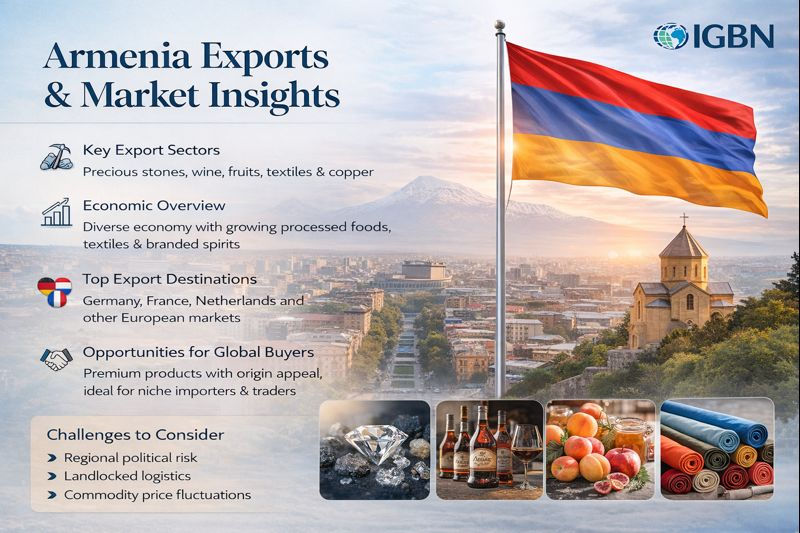
Armenia’s export sector is built on a strong foundation of minerals, agricultural produce, and select manufactured goods. Known globally for its premium wines, brandy, precious stones, and fresh fruits, Armenia offers niche export opportunities for international buyers seeking quality-driven and origin-specific products. Despite being landlocked, Armenia’s strategic location in the South Caucasus allows access to key regional markets across Europe, Eurasia, and the Middle East.
Economic Overview
Armenia has a mixed economy where mining, agriculture, and manufacturing play a central role. Exports remain a critical source of foreign exchange and economic stability. In recent years, Armenia has focused on expanding value-added sectors such as food processing, textiles, and light manufacturing, while also investing in technology-led industries.
However, regional geopolitical sensitivities and logistics constraints continue to influence export volumes and consistency.
Political & Trade Environment
Armenia is a member of the Eurasian Economic Union (EAEU), which facilitates trade with several neighboring economies. The government continues to pursue economic reforms and modernization initiatives to improve export competitiveness. While customs procedures and export compliance are well-defined, importers and partners must plan carefully due to regional political dynamics and evolving trade policies.
Key Export Products from Armenia
Armenia’s export portfolio is concentrated in the following categories:
Precious stones & metals – diamonds and gemstones
Wine & brandy – globally recognized Armenian spirits
Copper & mineral products – unrefined copper and ores
Fresh fruits & vegetables – apricots, peaches, pomegranates, tomatoes
Processed foods – jams, preserves, pickles
Textiles & garments – cotton fabrics and synthetic apparel
Dairy products – milk, cream, and cheese
Tobacco & agricultural inputs
These products appeal strongly to buyers looking for premium, origin-authentic goods rather than mass-market commodities.
Major Export Destinations
Armenia’s exports are primarily shipped to Germany, France, the Netherlands, and other European markets. These countries value Armenia’s specialty products such as optical components, garments, spirits, and precision industrial items. Europe remains Armenia’s most stable and high-value export destination.
Opportunities for Global Importers
Access to premium wine, brandy, and specialty foods
Growing availability of processed agricultural products
Competitive sourcing in textiles and light manufacturing
Strong demand in Europe for niche, quality-certified goods
Challenges to Consider
Regional geopolitical sensitivities
Limited port access due to landlocked geography
Export volumes can fluctuate based on commodity prices and logistics availability
How IGBN Supports Armenia Trade Exploration
IGBN helps international buyers and traders identify reliable Armenian exporters, evaluate product quality, and assess market feasibility. Through structured sourcing support, trade intelligence, and buyer–supplier matchmaking, IGBN reduces entry risks and improves trade efficiency for Armenia-focused sourcing strategies.
Armenia may not be a mass-export economy, but it holds strong appeal for buyers seeking differentiated products with heritage value. Armenian wines and brandy are increasingly positioned in premium segments across Europe and Asia, while its fresh and processed agricultural exports are gaining attention for quality and authenticity.
For international buyers, Armenia represents an opportunity to diversify sourcing away from overcrowded markets and engage with exporters who prioritize craftsmanship and quality over volume. With the right market intelligence and local support, Armenia can serve as a reliable sourcing destination for specialty goods.
IGBN bridges this gap by helping buyers navigate Armenia’s export ecosystem—connecting them with verified suppliers, understanding regulatory nuances, and enabling sustainable long-term trade relationships.

Comments